Mobile phones have become an essential part of everyday life in India. A SIM card is required not only for making calls and sending SMS messages but also for mobile banking, UPI payments, OTP verification, social media accounts and many other digital services. Because of this, the Government of India has introduced several rules to ensure that mobile connections are issued only after proper identity verification.
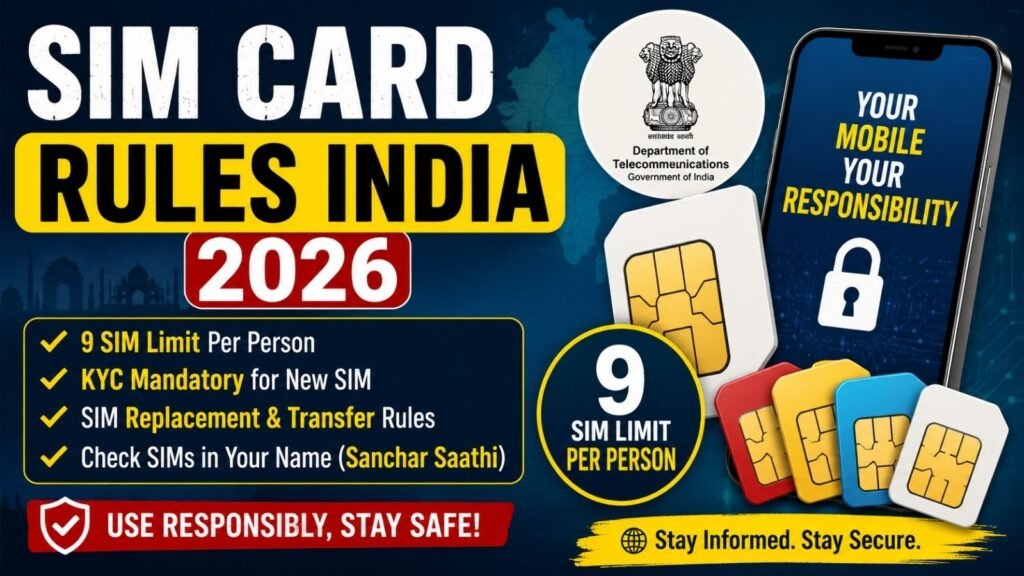
The Department of Telecommunications (DoT) has strengthened SIM-card and KYC procedures to reduce fake connections, cyber fraud, impersonation and misuse of mobile numbers. In 2026, consumers should be particularly careful about how SIM cards are purchased, transferred, replaced and used.
What Are SIM Card Rules in India?
SIM card rules are regulations issued by the Government of India and telecom authorities governing the purchase, activation, replacement and use of mobile connections.
Telecom operators must verify the identity of customers before activating a connection. Customers are expected to provide correct information and complete the required KYC process. Obtaining a SIM using fake documents, fraud or impersonation can result in legal action under the Telecommunications Act, 2023.
These rules are designed to ensure that every active mobile connection can be associated with a properly verified subscriber.
How Many SIM Cards Can One Person Have?
One of the most important SIM-card rules in India concerns the maximum number of mobile connections an individual can hold.
Under the DoT’s existing instructions, an individual subscriber can have up to 9 mobile connections across all telecom service providers and licensed service areas in India. This means the limit applies collectively rather than separately to each operator.
For subscribers in Jammu & Kashmir, Assam and the North-Eastern Licensed Service Areas, the applicable limit is 6 mobile connections.
For example, if a person already has five Airtel connections, two Jio connections and two Vi connections, the total is nine. The person cannot normally obtain another individual mobile connection without exceeding the applicable limit.
Subscribers who have connections beyond the permitted limit may be required to surrender, transfer or disconnect the additional numbers.
KYC Is Mandatory for SIM Activation
KYC, or Know Your Customer, is one of the most important requirements for getting a SIM card.
When purchasing a new SIM, the telecom operator must verify the customer’s identity using the prescribed KYC process. Depending on the applicable process, this can involve electronic or digital KYC and identity authentication.
The objective is to ensure that the information recorded by the telecom operator corresponds to the actual subscriber.
Customers should never provide false information or allow another person to obtain a SIM in their name for questionable purposes.
Rules for SIM Replacement or SIM Swap
If your SIM card is lost, damaged or stops working, you can request a replacement SIM from your telecom operator. However, SIM replacement is not simply a matter of collecting another card.
Current DoT requirements provide for identity re-verification when a subscriber replaces or upgrades an existing SIM. The 2026 framework also specifically identifies SIM replacement or upgrading as circumstances requiring re-verification through the applicable e-KYC or D-KYC process.
DoT has also updated procedures for SIM swap/replacement, including safeguards around identity verification and biometric authentication in applicable KYC processes.
Therefore, consumers should be prepared to complete the required verification when requesting a replacement SIM.
Can You Transfer a SIM Card to Another Person?
A mobile number should not simply be handed over to another person and treated as though the new person is the registered subscriber.
Under the current rules, changing the user of a telecommunications service is subject to specific conditions. For individual connections, transfer is permitted between blood relatives and legal heirs, subject to the prescribed documentation and verification requirements. The new user is treated as receiving a new telecommunication service connection and must undergo the required identity verification.
This is important because many people continue using SIM cards registered in someone else’s name. Such arrangements can create problems if the number is later involved in fraud, disputes or other illegal activities.
Do Not Give Your SIM to Someone Else
The DoT has specifically warned consumers about the risks of obtaining SIM cards in their own name and handing them over to other people.
A person may think that lending a SIM is harmless, but if the number is used for cyber fraud, cheating or other illegal activity, the registered subscriber may face serious problems during investigation.
The DoT has warned that SIMs obtained through fraud, cheating or personation are offences under the Telecommunications Act, 2023.
Therefore, you should use mobile connections registered in your own name and avoid allowing strangers or other people to use your identity to obtain telecom services.
Check Mobile Numbers Registered in Your Name
Many people are unaware that mobile connections may have been issued using their identity documents.
The Government’s Sanchar Saathi platform provides a facility called “Know Mobile Connections in Your Name.” It allows citizens to check mobile connections associated with their identity and report connections that they do not recognize or no longer require.
This is particularly useful if you have lost an old SIM, changed your mobile operator several times or suspect that someone has obtained a connection using your details.
You can access the official Sanchar Saathi portal to check the mobile connections associated with your identity.
What Should You Do If You Find an Unknown SIM?
If you discover a mobile number registered in your name that you do not recognize, do not ignore it.
You should use the Sanchar Saathi service to identify the connection and report it as appropriate. If necessary, contact the concerned telecom operator and request clarification or disconnection.
Taking action quickly can reduce the possibility of the number being misused for fraudulent calls, SMS messages, online accounts or other activities.
Rules for New SIM Cards
When purchasing a new SIM, consumers should follow these basic precautions:
- Purchase the SIM from an authorized telecom operator or authorized point of sale.
- Complete the required KYC process yourself.
- Check that your personal information is recorded correctly.
- Do not purchase a SIM using another person’s identity.
- Do not allow another person to use a SIM registered in your name.
- Keep your SIM and associated mobile number secure.
- Check your registered connections periodically through Sanchar Saathi.
The Government has also introduced registration and verification requirements for telecom Points of Sale to reduce fraudulent SIM issuance and identify rogue sellers.
What Happens If You Exceed the SIM Limit?
If an individual is found to have more mobile connections than permitted, the DoT may require the subscriber to surrender, transfer or disconnect connections so that the total comes within the applicable limit.
DoT’s subscriber-verification instructions state that connections beyond the prescribed limit can be flagged for re-verification, with options available for surrender, transfer or disconnection.
Therefore, people who have accumulated several old SIM cards should check whether those numbers are still active and whether they remain necessary.
SIM Card and Cybersecurity
A mobile number is now closely connected to banking, UPI, email, social-media accounts and government services. As a result, SIM security is also an important part of personal cybersecurity.
Never share your OTP, SIM PIN or sensitive KYC information with unknown callers. Be especially cautious when someone claims that your SIM will be blocked unless you immediately provide personal information.
The DoT’s Sanchar Saathi initiative also provides Chakshu, a facility through which citizens can report suspected fraudulent communications received through calls, SMS or WhatsApp.
Important SIM Card Rules at a Glance
| Rule | Key Information |
|---|---|
| Maximum individual connections | Generally up to 9 |
| J&K, Assam and North-East | Limit of 6 |
| New SIM | KYC/identity verification required |
| SIM replacement | Re-verification required |
| SIM transfer | Subject to prescribed conditions |
| Fake KYC/documents | Can lead to legal consequences |
| Unknown numbers in your name | Can be checked through Sanchar Saathi |
| Giving your SIM to others | Can create legal and security risks |
| Fraudulent communication | Can be reported through Chakshu |
Conclusion
SIM card rules in India are mainly intended to protect subscribers and prevent misuse of telecom services. The important points consumers should remember are the applicable limit on individual mobile connections, mandatory KYC, re-verification for SIM replacement, restrictions on transferring connections and the legal risks associated with fake documents or impersonation.
If you have multiple old SIM cards, it is a good idea to check which numbers are registered in your name and disconnect connections that you no longer use. The Sanchar Saathi portal provides a government facility for checking mobile connections associated with your identity and reporting unwanted or unauthorized connections.